Table of contents
- What is EN ISO 20471 (in plain English)
- EN ISO 20471 vs UK law: how it fits with UKCA/CE and employer duties
- Classes 1-3: what they mean on real worksites
- Labels, user instructions & care: what a compliant garment must tell you
- Testing & certification: who actually signs this off?
- EN ISO 13688 & companion standards (EN 343, etc.)
- Buyer checklist: how to specify hi-vis that stands up to real work
- How OAKLINE designs to (and beyond) EN ISO 20471
- FAQs
What Is EN ISO 20471?
EN ISO 20471 is the main standard for high-visibility clothing used in the UK and Europe.
It sets out how bright the fabric must be, how reflective the tape needs to perform, and how much of each is required to keep workers visible day and night.
In short: if a hi-vis garment meets EN ISO 20471, you can trust that it’s been independently tested to perform in real-world site conditions.
Official guidance from the Health and Safety Executive (HSE) supports the use of this standard across UK workplaces.
Why It Matters in the UK
EN ISO 20471 is what manufacturers follow.
But when it comes to selling or supplying garments in the UK, those garments must also carry a UKCA or CE mark.
- EN ISO 20471 = proves the garment’s performance.
- UKCA / CE marking = proves the garment’s legal compliance for sale in Great Britain or the EU.
Government guidance on using the UKCA mark explains the details.
Employers, meanwhile, must make sure PPE is suitable for the job — that’s written into UK law.
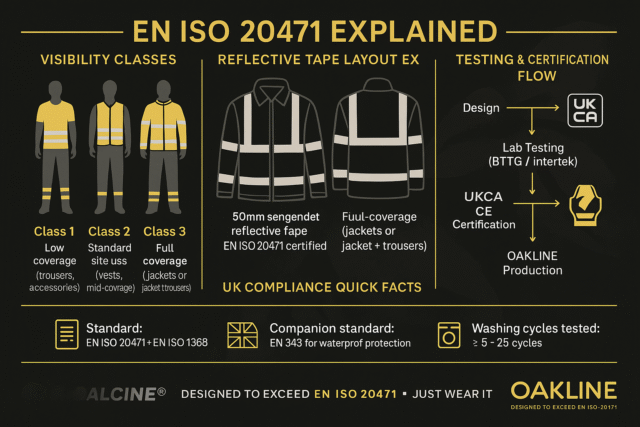
The Three Visibility Classes Explained
Hi-vis garments are grouped into Class 1, Class 2, and Class 3.
Each class tells you how much fluorescent and reflective material the garment has — and therefore how visible it is.
| Class | Typical garment | Coverage | Typical use |
|---|---|---|---|
| Class 1 | Trousers or accessories | Lowest | Minimal-risk areas |
| Class 2 | Vest, short-sleeve jacket | Medium | Construction, logistics |
| Class 3 | Long-sleeve jacket or jacket + trousers | Highest | Road, rail, night work |
For most UK worksites, Class 2 is the minimum.
Class 3 is required for roadside or rail work where full visibility is essential.
How Garments Are Tested
Every EN ISO 20471 garment must be tested by an accredited laboratory such as
BTTG or Intertek.
They check:
- Brightness of fluorescent fabric (daylight visibility)
- Retroreflective performance (night visibility)
- Strength and durability after washing
- Correct tape placement and garment design
Only when it passes these tests can it carry the EN ISO 20471 label and be certified under the UK PPE Regulation 2016/425.
Companion Standards: EN ISO 13688 & EN 343
Hi-vis clothing often needs to do more than just stand out.
That’s why you’ll usually see these extra standards on the same label:
- EN ISO 13688 – covers general clothing requirements such as sizing, seams, and labels.
- EN 343 – measures waterproofness and breathability for outdoor work.
For full protection, choose garments that meet both EN ISO 20471 and EN 343 — such as the OAKLINE PRO Kimi Jacket or Tod Bodywarmer.
The Buyer’s Quick Checklist
Before ordering hi-vis for your site team, check:
- The label clearly shows EN ISO 20471 and UKCA/CE marks.
- The class level (1, 2 or 3) matches the risk of your site.
- There’s a Declaration of Conformity available from the supplier.
- It’s tested by a UKAS-accredited lab such as BTTG.
- Washing and care instructions are clear and realistic for site use.
- Companion standards (EN 343, EN 13688) are present if needed.
- The supplier is reputable — ideally UK-based and recognised by Google as a Top Quality Store, like OAKEYS Safety Ltd.
How OAKLINE Goes Beyond the Standard
At OAKLINE®, we don’t stop at compliance.
We design every product to exceed EN ISO 20471 in comfort, fit, and durability:
- Breathable segmented reflective tape for movement
- Reinforced seams for long-term wash performance
- Modern ergonomic cuts tested for site mobility
Explore OAKLINE®:
- Shop the range
- Why OAKLINE
- Distributors
- Research/education posts you can interlink from this article:
9) FAQs
Is EN ISO 20471 legally required in the UK?
There isn’t a single law naming this standard; instead, the UK requires suitable PPE and relies on standards like EN ISO 20471 to demonstrate the necessary performance. Marking (UKCA/CE) handles legal placement on the market. HSEGOV.UK
What’s the difference between Class 2 and Class 3?
Class 3 gives higher visibility, typically via long sleeves and/or combining jacket + trousers to increase the visible area. Class 2 is common for most site tasks. ISO+1
Do I need EN 343 as well?
If workers face rain or spray, EN 343 ensures waterproof breathability alongside visibility. Many UK buyers specify EN ISO 20471 and EN 343 for outerwear. wiseworksafe.com
Who tests and certifies hi-vis?
Accredited labs (e.g., BTTG; global providers like Intertek). Always ask suppliers for a Declaration of Conformity and test reports. bttg.co.uk