

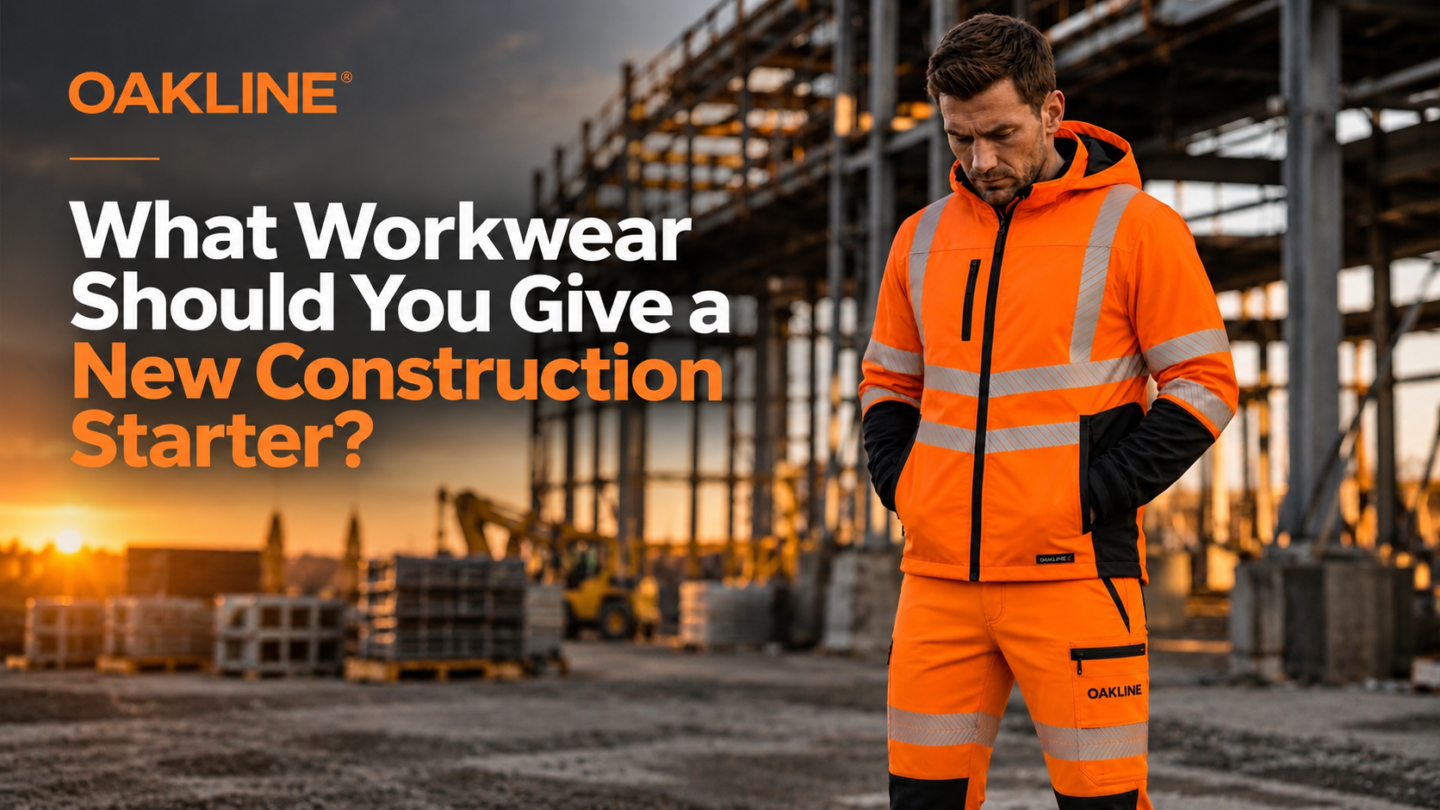
A new construction starter needs the PPE their risk assessment requires, fitted to them and provided free of charge. Build a consistent uniform around that PPE: trousers, a base layer, a mid-layer and an outer layer for the season. Then record their sizes. The next order takes minutes, not a morning of guesswork.
Construction needs people. A lot of them.
CITB’s Construction Workforce Outlook 2026 – 2030 estimates the UK needs an average of 41,200 extra construction workers every year to 2030. That’s around 206,000 over five years.
Every one of them walks through the door needing kit.
Why does new starter workwear go so wrong?
You know the system.
New starter is a Medium. There’s no Medium. Give them the Large.
The trousers are one brand. The T-shirt is another. The jacket still has the old logo on it. Someone digs out a hoodie from three winters ago.
Job done.
Except it isn’t.
You’ve spent time and money recruiting this person. Their kit shouldn’t be an afterthought.
What workwear does a new construction worker need?
There’s no universal list. It starts with the job.
Workwear and PPE are not the same decision. The employer has to establish what protection the work and the workplace require. HSE guidance says PPE selection should consider who is exposed, to what, and for how long. It should also account for the size, fit, compatibility and weight of the PPE.
Two points matter for every new starter:
- PPE that the risk assessment requires is provided free of charge. It doesn’t come out of the starter’s first wage packet.
- The duty isn’t limited to employees. Since April 2022, PPE duties also cover limb (b) workers, which matters when your new starter is casual or on a short-term contract.
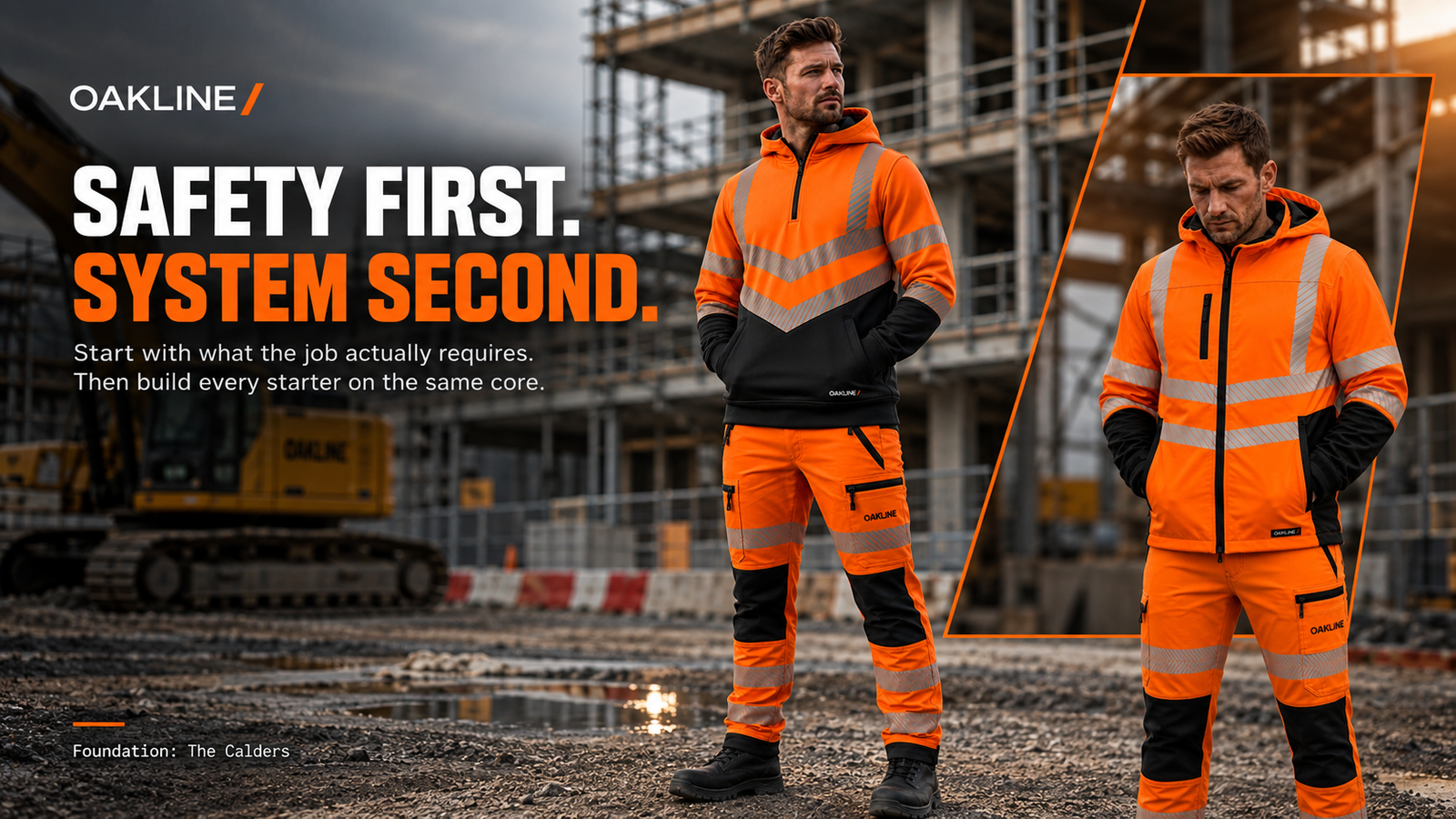
Safety requirement first. Uniform system second.
What should go in a new starter uniform?
Once you know what the role requires, make the uniform repeatable. You shouldn’t reinvent the order every time someone joins.
For an OAKLINE hi-vis setup, it starts with two garments.
The Calders hi-vis trousers. This is the foundation. The fabric is developed around 96% polyester and 4% spandex for stretch through a full day of movement. There’s zipped storage, black contrast panels and a sharper modern fit. The point isn’t just to issue something fluorescent. It’s a trouser someone could wear five days a week.
The Robin hi-vis T-shirt. This is the lighter layer up top. It’s lightweight and breathable, with a cleaner fit. The two-tone hi-vis orange and black, with its reflective tape layout, sits naturally with The Calders.
Robin and Calders. That’s your starting point.
How do you kit out a new starter for autumn and winter?
Someone starting in September needs more than a T-shirt. That doesn’t mean handing them the heaviest winter jacket on day one.
Build layers.
- The Cole hi-vis hoodie is the mid-layer. It has a quarter-zip and a zipped kangaroo pocket.
- The Tod hi-vis bodywarmer adds core warmth without restricting the arms.
- The Kimi hi-vis jacket is the outer layer, for when the role and conditions call for it.
Different conditions. Same product family. Same uniform.
That makes the next starter easier too.
How do you get workwear sizing right for new starters?
It sounds obvious. It isn’t always done.
HSE advises employers to choose PPE that suits the individual wearer, including size and fit. It’s also clear that altering unsuitable PPE to make it fit isn’t the answer.
Sizing also varies between garments. The Kimi, for example, is a deliberately slim modern fit. Someone who is normally a Medium and likes a close fit might take a Medium. The same person wanting room for winter layers underneath might be better in a Large.
So the answer isn’t “He’s a Medium. Order everything Medium.”
Get samples on people. Check movement. Check the layers together. Then record it.
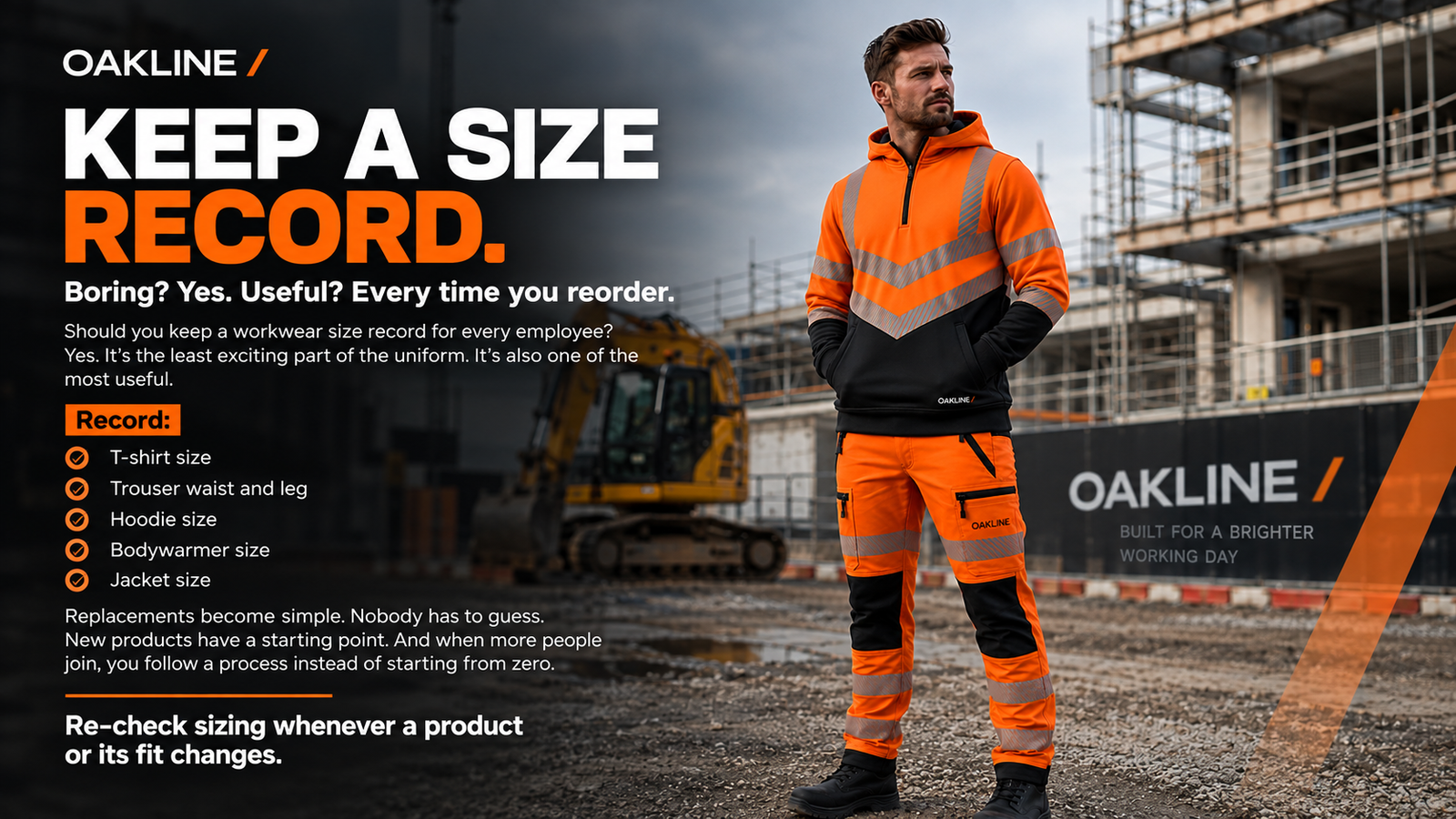
Should you keep a workwear size record for every employee?
Yes. It’s the least exciting part of the uniform. It’s also one of the most useful.
Once someone has been fitted, record:
- T-shirt size
- Trouser waist and leg
- Hoodie size
- Bodywarmer size
- Jacket size
Replacements become simple, because nobody has to guess. New products have a starting point. And when ten more people join, you’re following a process instead of starting from zero.
Re-check sizing whenever a product or its fit changes.
What do new starters on rail projects need?
Rail is different. Don’t treat it like any other site.
Hi-vis clothing on the GB mainline railway is covered by RIS-3279-TOM, the rail industry standard for hi-vis clothing. It sits alongside the principal contractor’s site rules and your own risk assessment.
Orange is the rail colour. But orange alone doesn’t make a garment suitable for rail work.
Before anything goes trackside:
- Check the garment against RIS-3279-TOM and the site’s requirements.
- Ask the supplier for the certification evidence for that specific garment.
- Don’t issue a garment for rail work if the paperwork isn’t there.
If you’re buying for rail, tell us upfront. We’ll tell you straight what’s documented for each garment.
Why is new starter kit becoming a bigger issue?
The workforce challenge isn’t hypothetical.
CITB’s New Entrant Support Team supported 5,913 apprenticeship starts in 2025/26, up 43% on the previous year. It also spoke to more than 20,000 employers about apprenticeship recruitment. Across CITB’s grant funding that year, 30,837 apprentices and 10,410 employers were supported. More than 9,000 of those employers were small or micro businesses.
This isn’t just Tier 1 contractors hiring by the thousand. Small firms are bringing people through too, and they need a straightforward way to kit them out.
The workforce is getting more local as well. CITB’s Workforce Mobility and Skills 2025 research found that 34% of construction workers had worked no more than 20 miles from home in the previous year. Only 10% had worked more than 100 miles away, down from 21% in 2015.
More local workforces mean more stable teams.
And teams should look like teams.
Does a consistent uniform actually matter?
Let’s be clear. Presentation isn’t protection.
A sharp uniform doesn’t make anyone more competent. It doesn’t replace training. And it doesn’t turn an unsuitable garment into suitable PPE.
But once the right protection is in place, there’s no reason for your workforce to look thrown together.
A clean, consistent uniform says one simple thing: we’ve thought about this.
That counts for trades working in customers’ homes, contractors meeting clients, facilities teams in occupied buildings and any business representing itself on a major site.
Where does OAKLINE fit?
OAKLINE is built for the affordable-premium position.
It’s not the cheapest garment on the rail, and it’s not overpriced corporate uniform either. It offers sharper fits, practical details and one product family that follows a worker through every season, instead of a different brand every few months.
Today, that starts with hi-vis. Next, the same approach extends into black and navy plain workwear, so businesses can run one uniform direction across every role.
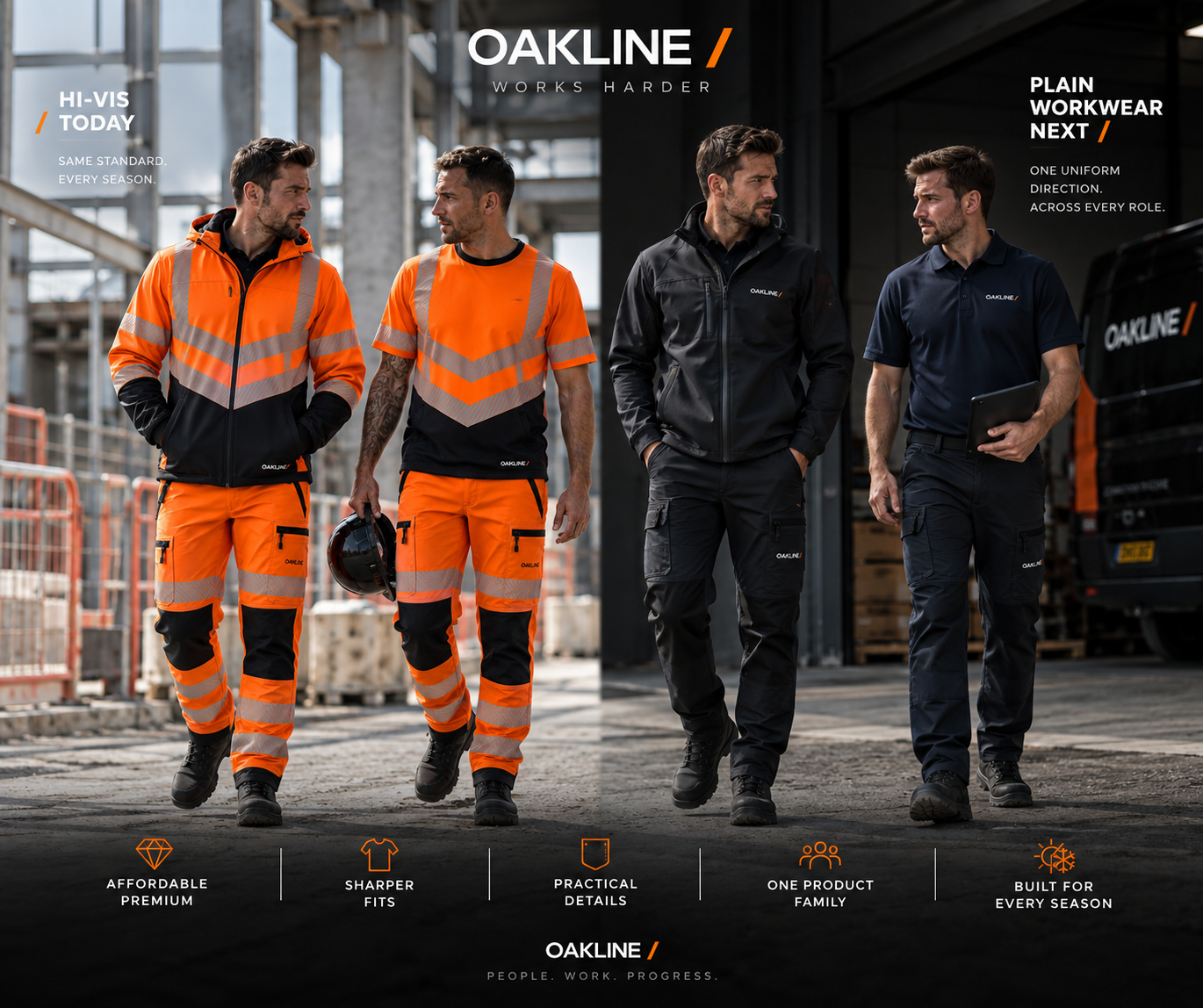
New starter. Same standard.
Someone joins Monday?
Know what the role needs. Know the range. Get them fitted. Record the sizes. Issue the right layers.
Then get them working.
Buy OAKLINE online, or ask your existing workwear supplier for OAKLINE.
FAQs
What workwear does a new construction worker need?
There’s no universal list. Start with the risk assessment, the role and the site requirements. Where PPE is required, select it for the actual hazard and the actual wearer. Then build the wider uniform around it.
Who pays for a new starter’s PPE?
PPE required by the risk assessment must be provided free of charge. Since April 2022, this duty also covers limb (b) workers as well as employees.
Should construction companies let workers try sizes before ordering?
For team orders or a new uniform rollout, yes. HSE guidance identifies size, fit, compatibility, weight and the wearer’s physical characteristics as selection considerations. Fitting first cuts returns and wasted stock.
Should new starters get summer and winter workwear?
Base it on the role, the season and the expected conditions. A layered uniform makes it easy to add or remove garments as conditions change.
Should a company record employee workwear sizes?
Yes. A size record makes replacements and future orders simple. Re-check sizing whenever a product or its fit changes.