

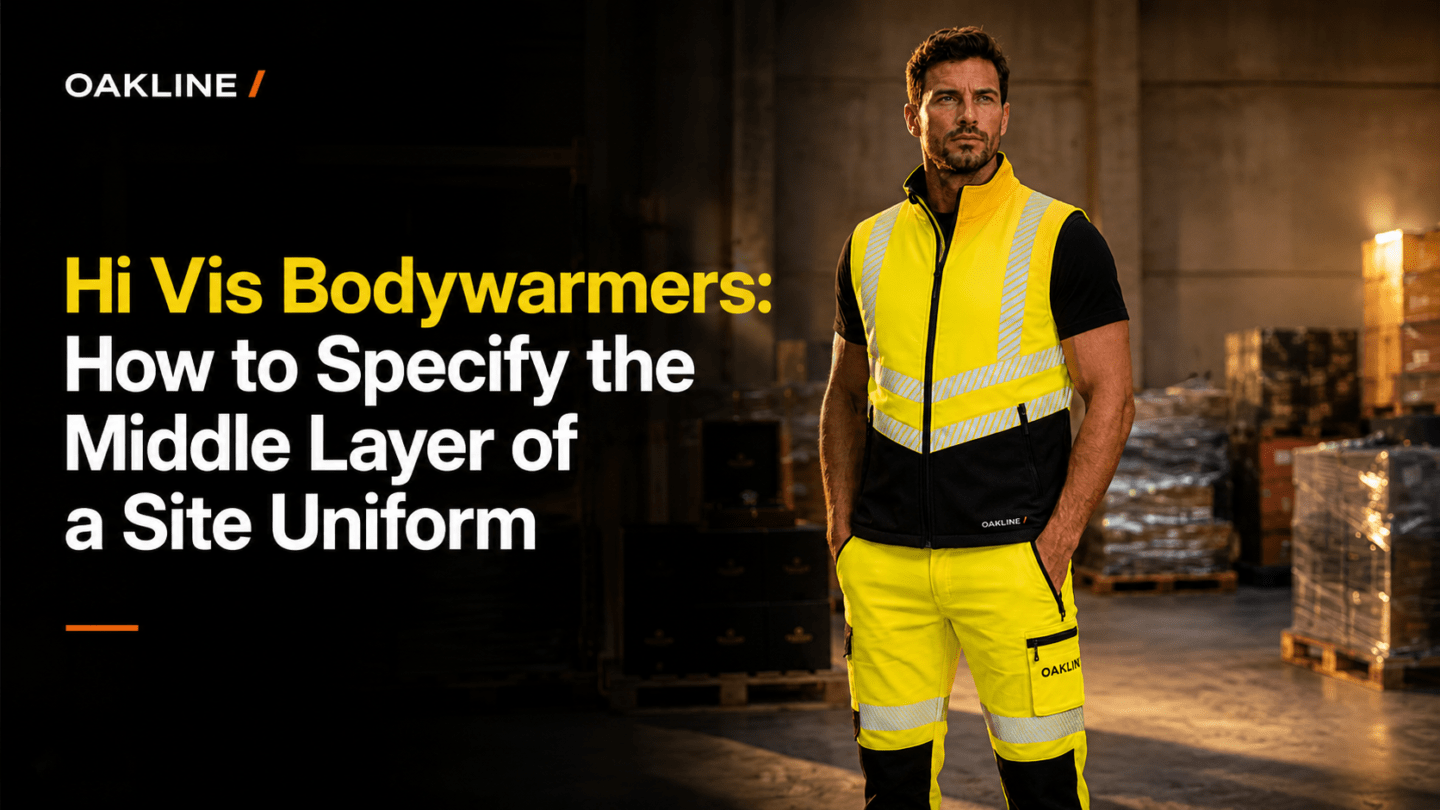
Most site uniform ranges jump from a lightweight T-shirt straight to a full jacket.
That leaves a gap.
On cool mornings, in breezy yards, inside loading bays or during stop start work, a jacket can feel like too much and a T-shirt can feel like too little. The missing piece is usually a mid layer that covers the core without enclosing the arms.
That is where a hi vis bodywarmer earns its place, and where the OAKLINE Tod sits in our range.
A bodywarmer is not a replacement for every jacket. It is a planned option inside a uniform system: sharper than a mismatched promotional gilet, less restrictive than full outerwear, and easier to combine with the rest of a team’s kit.
Build the uniform around real working conditions
Uniform buying often becomes a product by product exercise.
T-shirts are ordered for summer. Jackets are added later. A different supplier fills a shortage with generic bodywarmers. New starters receive whatever is left. Before long the workforce is wearing several colours, fits, tape layouts and branding positions.
The range was purchased. The uniform was never designed.
HSE guidance asks employers to treat clothing and uniform design as part of thermal comfort, and notes that multiple layers let workers make reasonable adjustments around their individual needs.
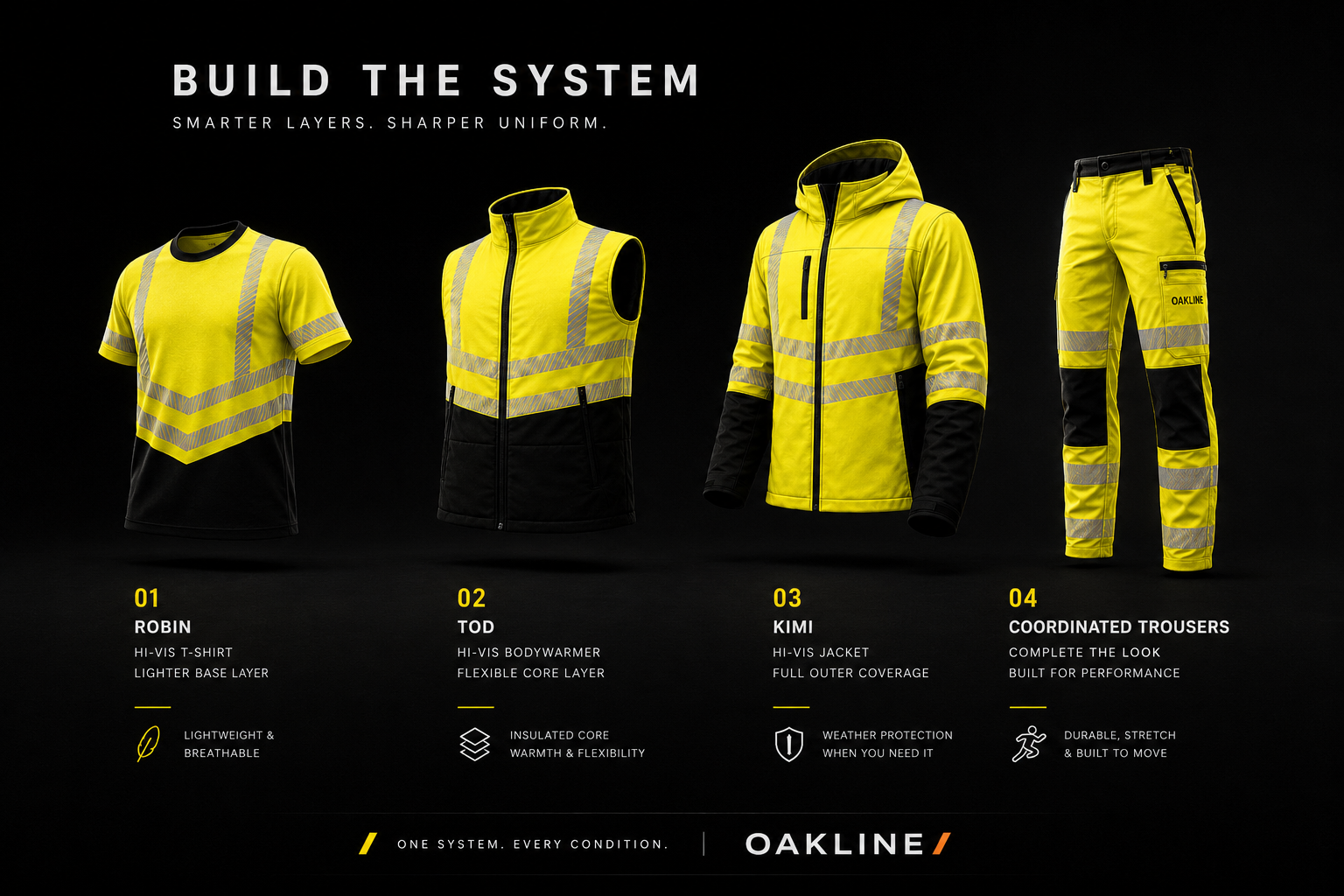
A planned system might run:
- The Robin hi-vis T-shirt as the lighter base layer
- The Tod hi-vis bodywarmer as the flexible core layer
- The Kimi hi-vis jacket when fuller outer coverage is required
- Coordinated trousers or joggers to complete the look
The exact combination must suit the job, weather, site rules and risk assessment. The principle is simple: issue planned options, not unrelated garments.
Where the sleeveless format works
A hi-vis bodywarmer adds torso coverage while leaving the arms open.
That suits active roles: driving, loading, picking, carrying, climbing, supervising, and moving between indoor and outdoor areas. It is also the easiest layer to remove as temperature or activity changes.
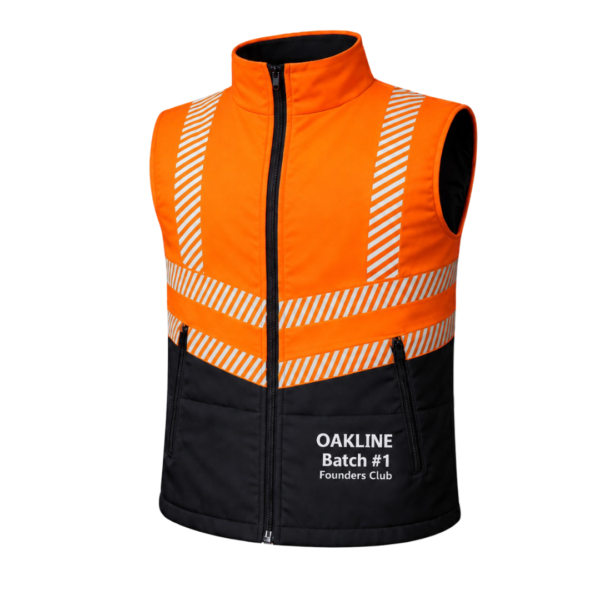
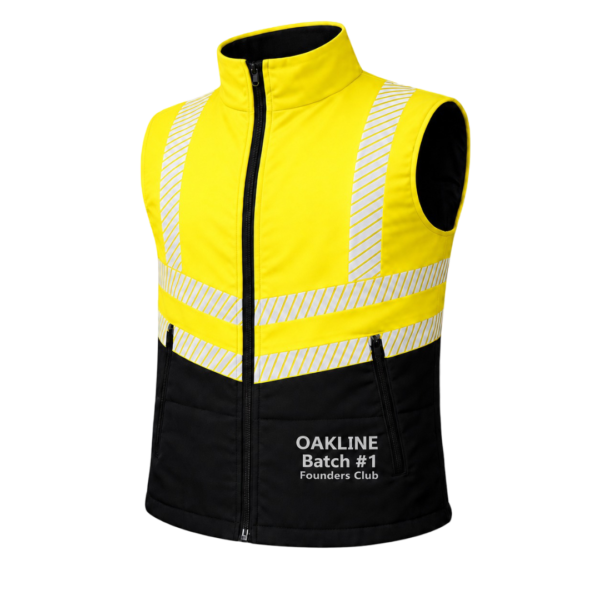
The Tod is designed for that middle position. Its development specification includes a 300D Oxford outer, insulated padding, segmented reflective tape and a full front zip. The sleeveless cut preserves movement around the arms, and the orange-and-black or yellow-and-black layout gives teams a more coordinated appearance than mixed-supplier kit.
Those are design and product points. They do not replace certification, supporting documentation or a site-specific risk assessment.
The class limit every buyer should know before specifying
This is the point most bodywarmer listings avoid.
Under EN ISO 20471, Class 3 requires a garment with sleeves carrying retroreflective bands. A sleeveless garment cannot reach Class 3, whatever the fabric or tape layout. Sleeveless hi-vis garments are limited by their conformant surface area, which is why waistcoats and bodywarmers typically sit at Class 1 or Class 2 where they are certified at all.
Two further points worth holding onto:
Black panels are styling, not compliance. Only fluorescent yellow, orange or red qualify as conformant background material under EN ISO 20471. Black or charcoal panels contribute nothing to the class calculation, however good they look.
A bodywarmer alone may not satisfy a Class 3 site. If your risk assessment specifies Class 3, the bodywarmer must be worn as part of a certified combination, or under an outer garment that carries the required certification in its own right. Combinations only count where they have been tested and certified as a set.
Ask for the current test status, markings, declaration of conformity and user instructions before you specify or advertise any hi-vis garment as approved. Until those are confirmed, do not make a class claim.
Rail sites: orange is not the same as compliant
Construction and rail buyers are not buying the same garment.
Network Rail infrastructure work is governed by RIS-3279-TOM, which sets its own requirements for hi-vis clothing on or near the line, including a specified orange base colour and defined garment configurations. An orange-and-black bodywarmer is not automatically RIS-3279-TOM compliant. The garment has to be certified against that standard, and evidence must be available.
If you are buying for a rail contractor, principal contractor or infrastructure framework, confirm two things separately:
- The EN ISO 20471 class and certification status
- Whether the garment is certified to RIS-3279-TOM for the work being carried out
Buying for a mixed fleet? Split the specification. Do not assume one garment clears both routes.
Test fit as a complete outfit, not garment by garment
Fit is usually treated as a problem to solve after delivery. It should be part of selection.
HSE’s PPE guidance asks employers to consider size, fit, compatibility, weight and the physical characteristics of the wearer, and states that items worn together must work together effectively.
Before you commit to a full uniform, test the actual combinations:
- Does the bodywarmer sit comfortably over the chosen T-shirt, sweatshirt or hoodie?
- Can the wearer bend, reach and drive without it riding up?
- Can the jacket be worn over it when the uniform plan requires another layer?
- Does the size allocation reflect real wearers rather than a generic spreadsheet?
A short wearer trial across several job roles will expose issues before rollout. Include people who drive, lift, climb, work at desks and move between temperatures.
The goal is not tight garments. It is a cleaner shape that still works for the task and the planned layers.
Premium-budget means value, not cheapest
The lowest unit price is easy to approve. It does not automatically produce the best-value uniform.
Public procurement guidance frames value for money in terms of the right goods at the right price and quality, not price alone. The same logic applies to private buyers running a uniform budget across a full year, including replacement rates and reissue.
A premium-budget strategy sits between two weak extremes:
- Cheap generic garments selected mainly on unit price
- Corporate uniform programmes that are hard to justify for active site teams
The better question is not “is this the cheapest bodywarmer?” It is “does this help us build a more wearable, consistent uniform without moving into corporate uniform pricing?”
Verify claims, not product titles
BSIF has reported that a high proportion of PPE assessed from suppliers outside its Registered Safety Supplier Scheme failed one or more performance, documentation, certification or marking requirements during testing. Its sample included hi-vis jackets, with a substantial share failing brightness and visibility requirements.
That applies to the tested sample, not the whole market. The lesson still holds: verify against documentation rather than a product title, marketplace listing or photograph.
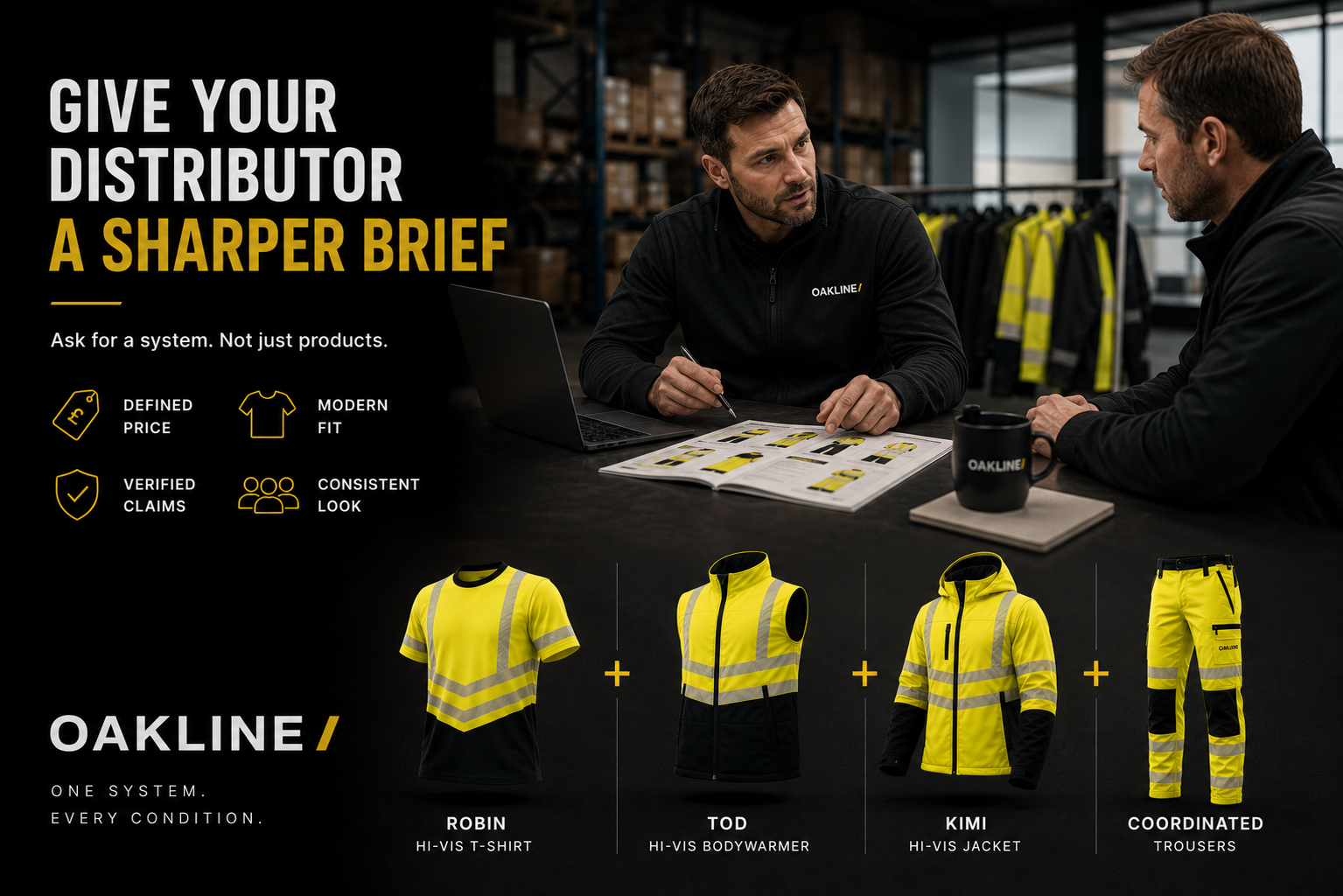
Give your distributor a sharper brief
You do not need to leave a distributor you already trust. You need to ask for a better system.
Use this:
“We want a coordinated hi-vis uniform with a modern fit. We need a lightweight T-shirt, a practical bodywarmer for changeable conditions and a fuller jacket option. The range must look consistent, remain realistic for volume issue, and use only verified compliance claims with documentation supplied. Please include OAKLINE in the options.”
That changes the conversation. You are no longer asking for some bodywarmers. You are asking for a uniform system with a defined price, fit, appearance and verification standard.
The Tod is the bridge
Strong uniform ranges are not built around one hero garment. Each layer has a job.
The Robin handles lighter conditions. The Tod adds flexible core coverage. The Kimi provides the fuller outer option. Coordinated lower-body garments complete the team look.
The Tod matters because it fills the gap between not enough and too much.
For trades, construction teams, logistics operations and facilities crews, that turns a random clothing issue into a sharper, more practical hi-vis uniform system.
[View the OAKLINE Tod] | [Open a trade account]