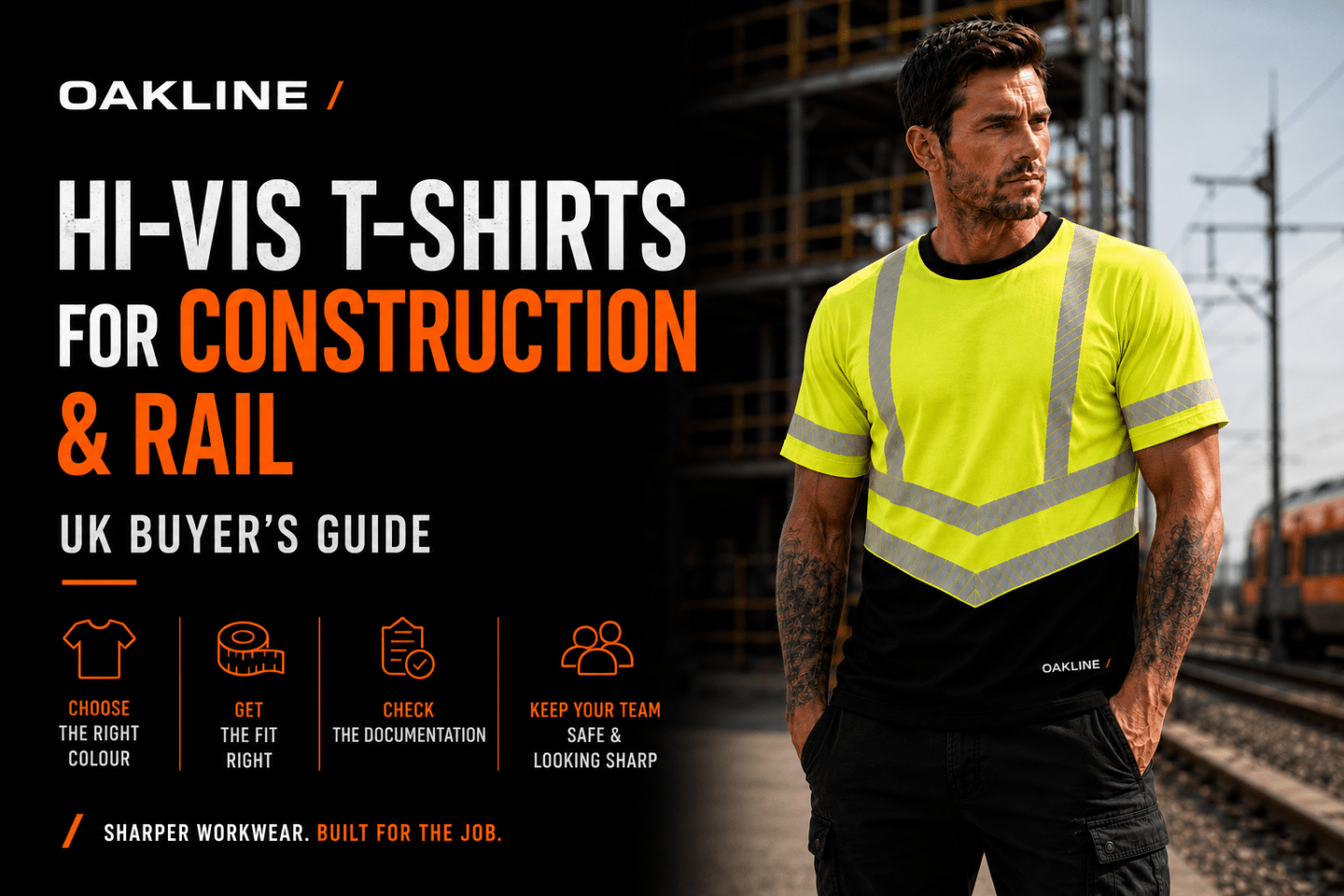
Hi-Vis T-Shirts for Construction and Rail: UK Buyer’s Guide
Buying hi-vis t-shirts looks straightforward until you are actually doing it. Then you have to choose sizes for thirty workers you have never measured, decide whether orange or yellow is a preference or a requirement, get the company logo on without wrecking the garment, keep the team comfortable through July, and make sure you can still buy the identical product when four new starters arrive in September.
Most suppliers will send you a price per unit and nothing else. This guide covers what to check before you approve that quote.
Start with colour, not price
Colour is the first decision, and for some teams it is not a decision at all.
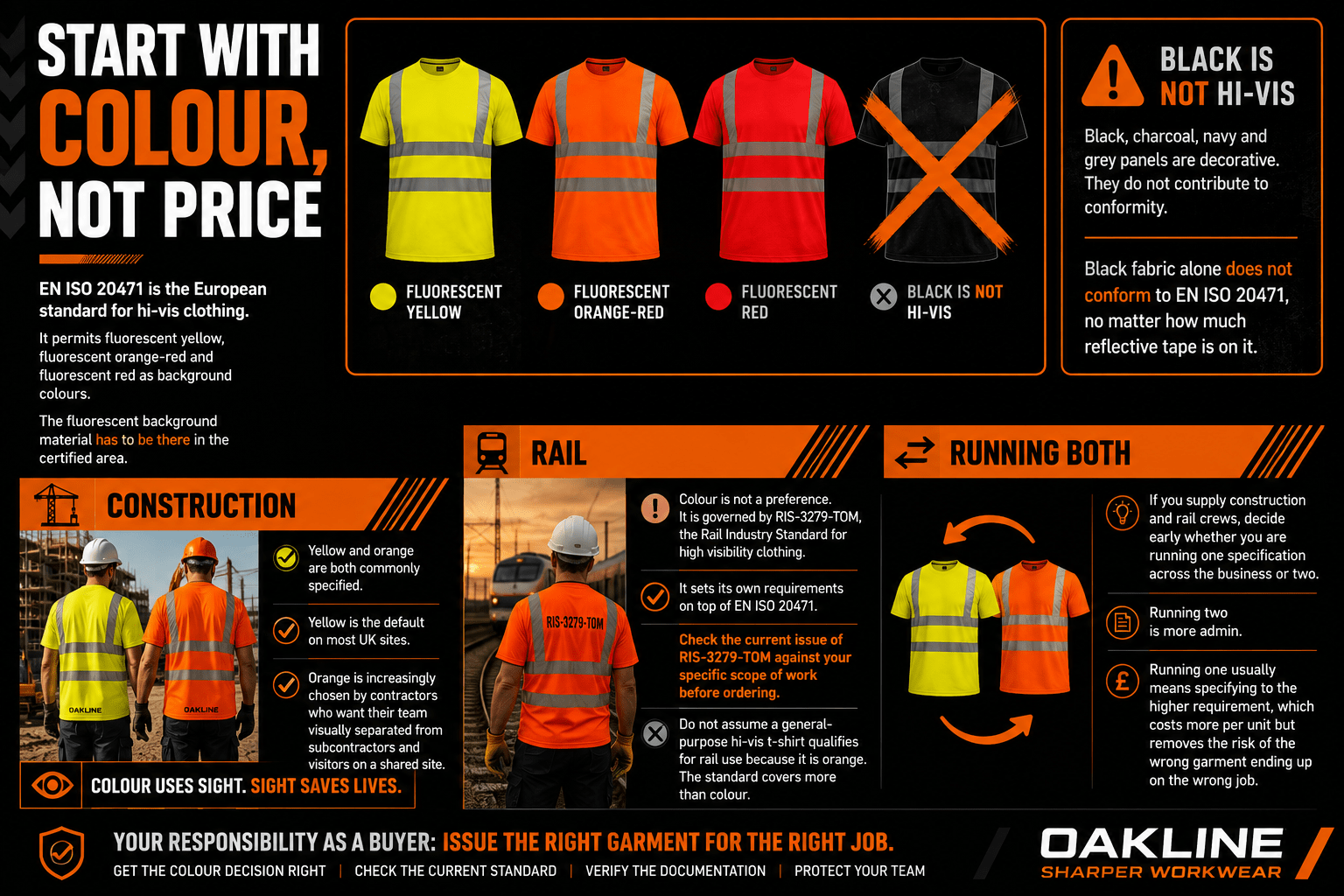
EN ISO 20471 is the European standard for hi-vis clothing. It permits fluorescent yellow, fluorescent orange-red and fluorescent red as background colours. Black, charcoal, navy and grey panels are decorative. They do not contribute to conformity, and a garment made from black fabric alone does not conform to EN ISO 20471 no matter how much reflective tape is on it.
That matters because a lot of what gets sold online as “black hi-vis” is a fashion garment with tape on it. If the garment is being issued as PPE, the fluorescent background material has to be there in the certified area.
Construction
Yellow and orange are both commonly specified. Yellow is the default on most UK sites. Orange is increasingly chosen by contractors who want their team visually separated from subcontractors and visitors on a shared site.
Rail
Colour is not a preference. Work on or near the line in the UK is governed by RIS-3279-TOM, the Rail Industry Standard for high visibility clothing, which sets its own requirements on top of EN ISO 20471. Check the current issue of RIS-3279-TOM against your specific scope of work before ordering. Do not assume a general-purpose hi-vis t-shirt qualifies for rail use because it is orange. The standard covers more than colour.
Running both
If you supply construction and rail crews, decide early whether you are running one specification across the business or two. Running two is more admin. Running one usually means specifying to the higher requirement, which costs more per unit but removes the risk of the wrong garment ending up on the wrong job.
What to check before you order
The HSE position on PPE selection is that the choice should account for the hazard, the level of exposure, the work being done, and the physical characteristics of the person wearing it, including size, fit and compatibility with other equipment.
Applied to hi-vis t-shirts, that means checking:
The work and the site. Traffic management, plant movement, lighting conditions and whether the garment is worn as the visible outer layer or under a jacket.
Your own risk assessment. The garment specification should come from the assessment, not the other way round.
Intended use. A t-shirt certified as a standalone garment is not the same as one certified only as part of an ensemble.
Fit and movement. Covered in detail below.
Summer conditions. A t-shirt exists because the jacket comes off. If the team will not wear it in August, it fails.
Compatibility. Harness, tool belt, knee pads, over-trousers, radio clip. Test the combination, not the garment on its own.
Contamination and washing. Hi-vis performance degrades with wash cycles. Ask for the manufacturer’s maximum wash count.
Continuity of supply. Will this exact product still be available in twelve months.
That last point is where most bulk workwear orders go wrong.
What documentation should the supplier provide?
This is the section most buyers skip and the one that carries the most risk.
For any hi-vis garment issued as PPE, ask the supplier for documentation tied to the exact product, exact model and exact colour you are buying. Not the range. Not a similar item. Specifically: manufacturer identity, the stated intended use of the garment, applicable test evidence and certification, the Declaration of Conformity, correct UKCA or CE marking, and the manufacturer’s user information including wash care and lifespan.
If a supplier cannot produce this quickly, that tells you something.
What the BSIF testing found
The British Safety Industry Federation published findings in its white paper Combatting Substandard PPE in the UK, based on testing between January 2025 and January 2026. BSIF assessed 88 PPE products sourced from suppliers outside its Registered Safety Supplier Scheme, running 116 individual tests alongside reviews of certification, technical documentation and product marking. Only 18% met all applicable regulatory requirements. The remaining 82% failed on technical performance, missing or invalid certification, inadequate documentation, incorrect marking, or a combination.
Two things to be clear about. That 82% figure applies to products from non-registered suppliers, not to the UK PPE market as a whole. Product from BSIF Registered Safety Suppliers showed a 96% compliance rate in the same programme. The point is not that PPE is generally unsafe. The point is that documentation and marking failures are common enough at the cheap end of the market that verifying them is now part of the buying job.
Under UK PPE regulations, a product without valid certification, a Declaration of Conformity or correct marking is non-compliant regardless of how it performs in a lab. You can buy a garment that would pass the test and still be issuing non-compliant PPE.
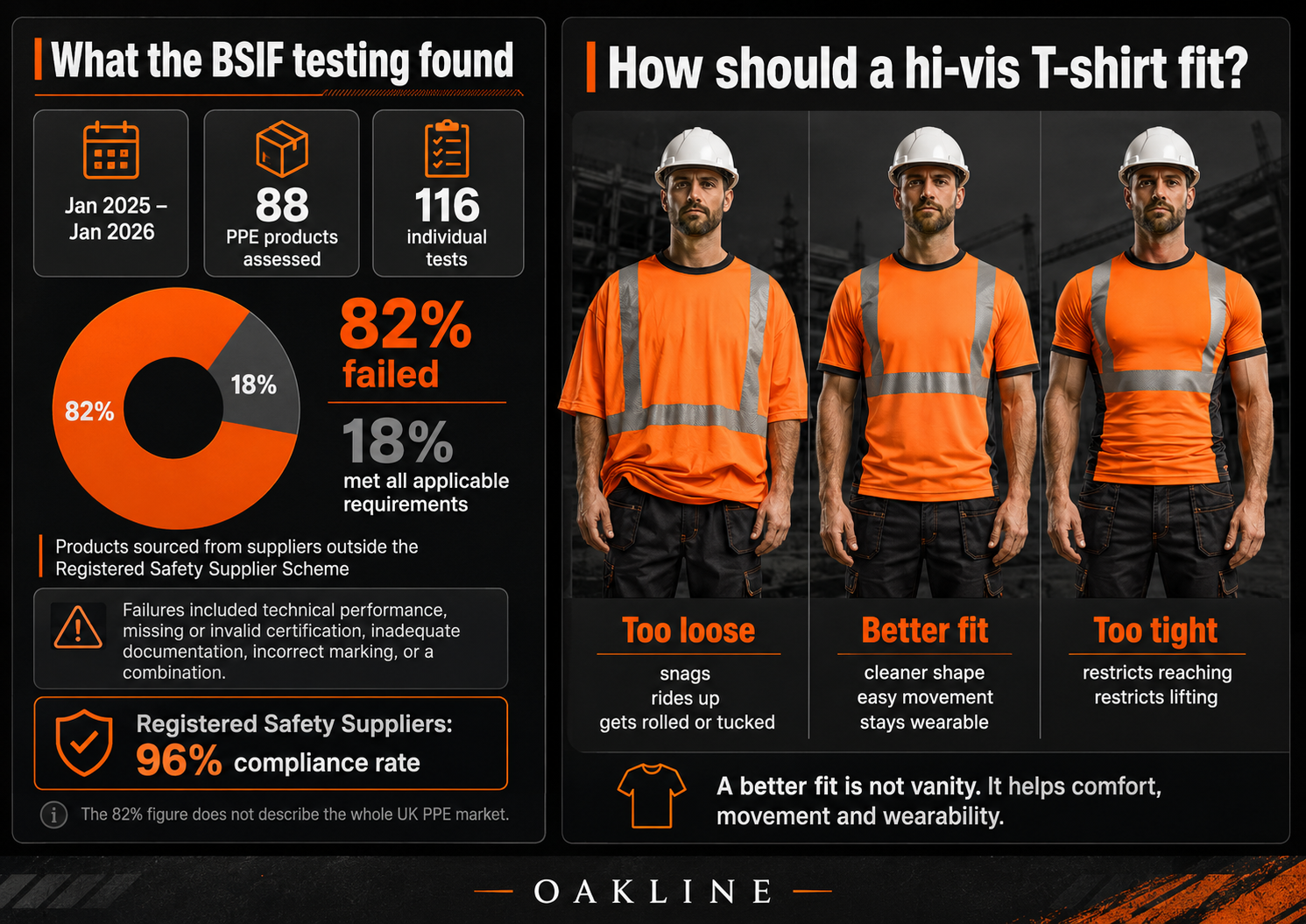
How should a hi-vis t-shirt fit?
Nobody is looking for a tailored fit on site. But there is a lot of ground between tailored and the traditional workwear cut, which on most builds hangs like a bin bag.
A better fit is not vanity. A garment that is too loose snags on plant and scaffold, rides up under a harness, and gets rolled, tucked or taken off, at which point it is not doing its job. A garment that is too tight restricts reaching and lifting and gets the same treatment.
How to test fit properly
Get the full size chart with actual measurements, not just S to 3XL. Trial on at least four different body shapes from your own team, not the two people who happen to be in the office. Test real movements including overhead reach, bending, kneeling, climbing a ladder and wearing a harness. Check the garment still sits correctly when worn under the jacket you actually issue.
The OAKLINE Robin is cut with a cleaner modern fit than traditional loose-cut workwear. It is aimed at teams that want a sharper look on site without moving to corporate uniform pricing.
Should you put the company logo on it?
For most construction and rail buyers, yes. Branded hi-vis identifies your team on a shared site, deters unauthorised access, and is the cheapest brand visibility you will ever buy.
What to agree before the order
Position. Left chest and full back are standard. Confirm the back print does not clash with the reflective tape layout.
Method. Print or embroidery. Both have implications for cost, minimum quantity and durability through wash cycles.
Additional marking. Worker name, job role, TRAINEE or similar.
Minimum quantities. Decoration minimums are often higher than garment minimums.
Artwork setup. One-off charge, and whether the supplier retains the artwork for repeat orders.
Repeat order pricing. Adding four shirts in September should not cost what the first thirty did per unit.
Returns. Decorated garments are usually non-returnable. Confirm before you commit.
The point most buyers miss
Decoration must not be applied over the reflective tape or the fluorescent background material in a way that alters the certified configuration. Any branding that reduces the visible area of certified material can invalidate the garment’s conformity. A competent decorator will already know this. Ask anyway.
How many should each worker get?
There is no universal number, and any supplier who gives you one is guessing.
The right issue quantity depends on shift pattern, laundry arrangements, how dirty the work is, and how fast garments get damaged. Work out how many clean shirts each worker needs between wash cycles, then hold spare stock on top for damage, size exchanges and new starters.
The practical failure is not under-ordering the initial issue. It is having no buffer, so the first four new starters spend a month in the wrong colour.
How to avoid sizing problems on a bulk order
Sizing is where bulk workwear orders quietly waste money.
Get the full size chart with garment measurements in centimetres. Do not assume one brand’s Medium matches another’s, because they rarely do. Run a physical size trial with a spread of builds before the main order. Record what each worker selected and keep the record, because you will need it in six months. Confirm the exchange policy on undecorated stock. Hold a small buffer of the most common sizes. Use the identical approved garment for all replacements so the team does not end up in three shades of orange.
What do hi-vis t-shirts cost?
Broadly, the UK market splits three ways.
Budget import, roughly £4 to £8 per unit
Thin fabric, generic cut, high variance between production runs, and this is the tier where documentation problems concentrate. Viable for visitor stock and short-term hire. Risky as standing issue.
Mid-market, roughly £9 to £16
Consistent sizing, reliable repeat availability, documentation usually in order.
Premium, £17 and up
Better fit, better fabric, longer service life, stronger visual identity.
What actually drives the price
Fabric weight and quality, certification level, colour, whether the reflective tape is segmented, order quantity, decoration, and whether the supplier holds UK stock or ships to order. A quote that is materially below the rest is usually cutting one of those, and it is worth knowing which.
Judge on cost per wear, not cost per unit. A £7 shirt replaced three times a year is more expensive than a £14 shirt that lasts eighteen months, before you count the admin of reordering.
The OAKLINE Robin
The Robin is OAKLINE’s hi-vis t-shirt for teams that want to look like a professional outfit rather than a bag of spares.
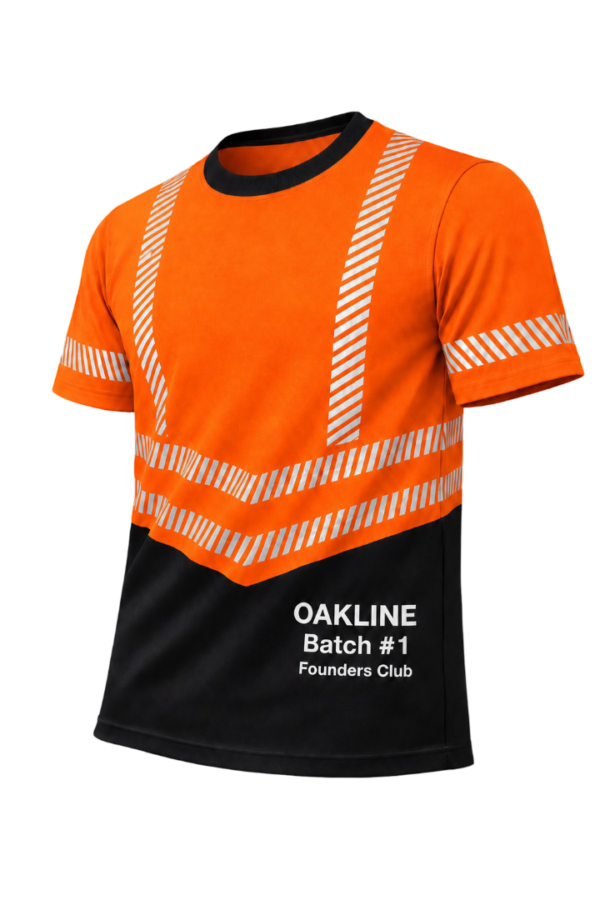
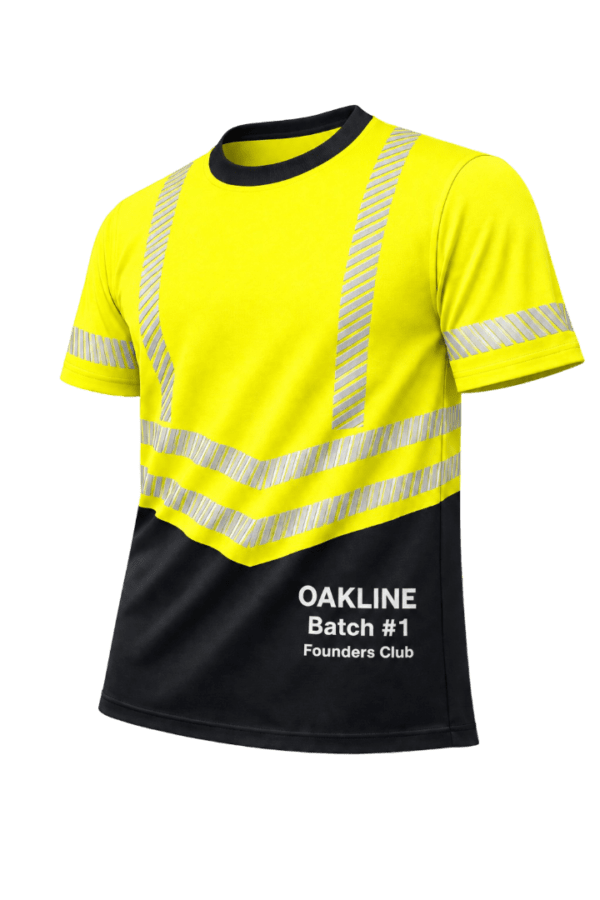
Lightweight summer build. Breathable feel. Short sleeve. Cleaner modern fit than traditional workwear. Reflective tape layout. Orange and black in the OAKLINE house style.
It is built for the point in the year when the jacket comes off and the t-shirt becomes the garment your workforce is judged on.