

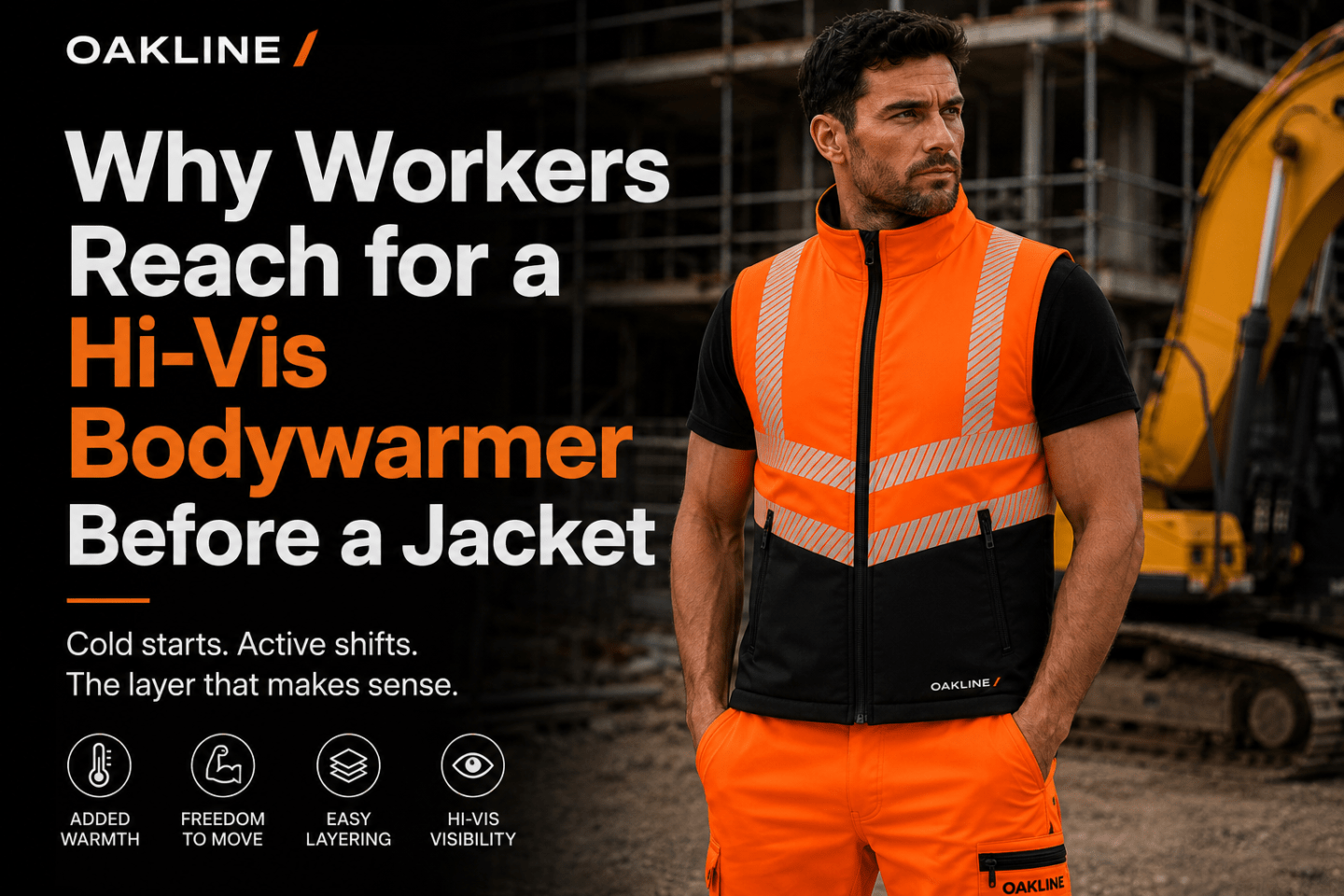
The most useful piece of workwear is not the heaviest one.
It is the garment that matches the conditions, works with the job, and stays on.
That is why a hi vis bodywarmer often gets picked up before a full jacket does.
A cold start does not mean a full day of cold weather. An outdoor task moves indoors. A quiet first hour turns into lifting, loading and climbing. The garment that felt right at 6am feels excessive by 9.
This guide compares the two so you can decide which to issue, and when you need both.
Hi vis bodywarmer vs jacket at a glance
| Hi Vis Bodywarmer | Hi Vis Jacket | |
|---|---|---|
| Coverage | Torso only, arms free | Full upper body including arms |
| Best for | Cold starts, active work, indoor/outdoor movement | Sustained cold, rain, wind, static work |
| Movement | Less restriction through the shoulders and arms | More restriction, depending on cut |
| Layering | Sits over t-shirt, polo, sweatshirt or hoodie | Usually the final outer layer |
| Weather protection | Limited, product dependent | Product dependent, often includes waterproofing |
| Certified fluorescent area | Smaller, sleeveless construction | Larger, sleeves add background material |
| Typical wear window | Autumn through spring, most of the working day | Deep winter and wet conditions |
| Time on before removal | Longer during active work | Often removed once the work rate rises |
Neither replaces the other. Most UK operations need both, issued for different parts of the year and different parts of the shift.
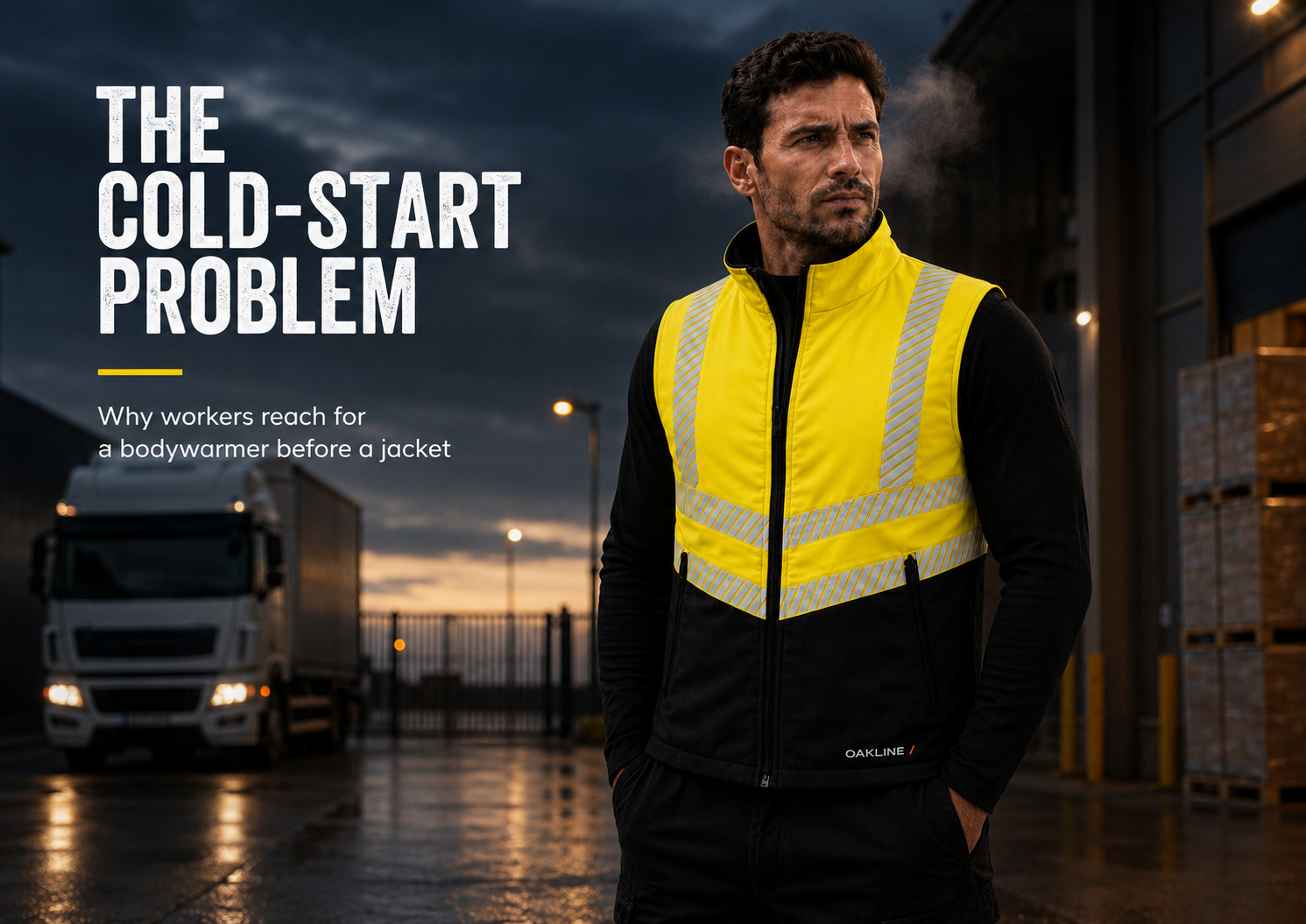
The cold start problem
Early starts are normal in construction, logistics, transport and facilities work.
Workers arrive before it is properly light. Vehicles, warehouses and site cabins are still cold. A t-shirt or sweatshirt is not enough for the first tasks.
The obvious answer is a full jacket.
That works when conditions require it. It does not follow that workers will stay in full outerwear once they start moving.
HSE says outdoor weather can seriously affect workers’ health when risks are not properly managed. Its thermal comfort guidance recommends selecting clothing carefully, ensuring workers do not wear more than necessary, and allowing adjustment through multiple layers.
A bodywarmer is not a substitute for assessing the weather, workplace or task. It is another layer to consider when the working day is going to change.
Why the jacket comes off first
Full jackets provide arm coverage and, depending on the product, weather protection or other tested properties.
Those sleeves are not required for every task or every stage of the day.
A worker spends the first hour in a yard, then moves into a heated warehouse.
A driver moves repeatedly between a cab and an outdoor loading area.
A tradesperson starts in the cold, then moves into physically demanding work.
As the work rate rises, the jacket becomes more than the wearer needs. Off it comes, and often it stays off, which leaves the worker in a base layer with no hi-vis outer at all.
That is the real issue. A garment removed at 9am is not protecting anyone at 11.
Why a sleeveless hi-vis bodywarmer stays on
A sleeveless design leaves the arms uncovered by the outer garment.
That reduces restriction during reaching, driving, carrying and repeated upper-body movement, though the result still depends on fit, sizing and what is worn underneath.
It also combines more easily with a t-shirt, sweatshirt or hoodie. The wearer gains insulation around the torso without adding an outer sleeve.
This is the commercial argument for The Tod. It is not trying to replace the jacket. It covers the stretch of the day when workers have not decided they need one.
For sustained cold and wet conditions, pair it with The Kimi hi-vis jacket and issue both.
When you need the jacket, not the bodywarmer
Be clear about the limits.
Issue a jacket where the work involves:
- Sustained exposure in genuinely cold or wet conditions
- Static roles such as gate marshalling, banksman duties or traffic management
- Overnight and winter shift work
- Any task where wind chill is a material factor
- Any requirement where a higher certified class is specified than a sleeveless garment can achieve
A bodywarmer is a layering option, not a downgrade you apply to save money on outerwear.
Compliance: what a sleeveless garment changes
This is where the comparison stops being about comfort.
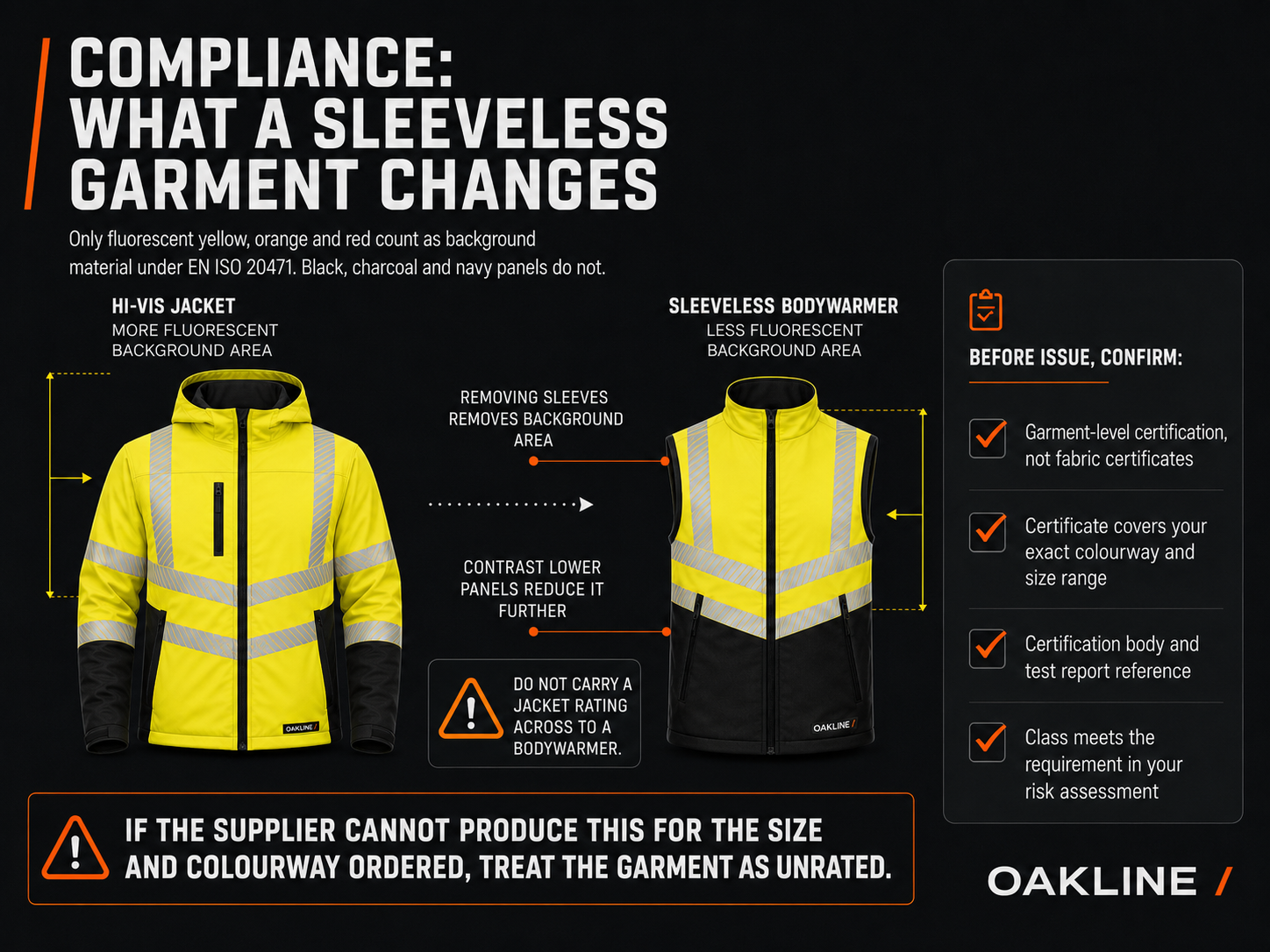
Only fluorescent yellow, orange and red count as background material under EN ISO 20471. Black, charcoal and navy panels do not, however sharp they look.
Two things follow for any bodywarmer. Sleeveless construction has less material to work with than a jacket, so removing sleeves removes background area. Contrast lower panels reduce it further.
So the class a jacket achieves is not the class the equivalent bodywarmer achieves. Never carry a rating across from one garment to another, and never assume one from appearance.
Before issue, confirm:
- Garment-level certification, not fabric certificates
- That the certificate covers your exact colourway and size range, since smaller sizes can drop a class
- The certification body and test report reference
- That the class meets the requirement in your risk assessment for the specific task
If the supplier cannot produce that for the size and colourway you are ordering, treat the garment as unrated.
Rail work: RIS-3279-TOM and orange background
Rail is a separate specification, not a stricter version of the construction one.
Work on or near the line falls under RIS-3279-TOM, which sets its own requirements for hi-vis clothing in the rail environment, including orange as the background colour for upper body garments.
Yellow hi-vis that is fine on a construction site is not automatically acceptable trackside. A bodywarmer is not automatically acceptable in place of the specified garment type either.
Before issuing any hi-vis bodywarmer to rail personnel:
- Confirm certification against the applicable rail requirement, not just EN ISO 20471
- Confirm the colourway is correct for the intended work
- Confirm your principal contractor’s site rules, which can go further than the standard
Depot, yard, compound and general contractor use may sit under different requirements to on or near the line. Get that boundary confirmed in writing before ordering in volume.
Workers use clothing that suits them
Workwear buying often happens without involving the people who wear it.
Review the catalogue. Agree a price. Collect a size spreadsheet. Boxes arrive.
Quick, but it skips the question that decides the outcome: will the team wear it?
HSE selection guidance says employers should involve workers when choosing PPE, because they are then more likely to understand its importance and use it. Buyers are also told to consider size, fit, compatibility, weight and the physical characteristics of the wearer. Supporting HSE guidance goes further, stating that involving end users in decisions about fit, comfort, compatibility and wearability is likely to improve acceptance.
A badly fitting garment does not become a good purchase because it was cheap. It becomes an unworn one.
Where cheap hi-vis bodywarmers go wrong
The category has plenty of functional products. It also has plenty that feel like an afterthought.
The recurring complaints:
- Excessive width through the body
- Bulky shaping across the chest
- Oversized arm openings that let cold air straight in
- Poor fit over the intended underlayer
- A hem that rides up when sitting
- Generic styling that makes a team look inconsistent
- Sizing chosen without a trial
A loose fit is not automatically wrong. Some wearers need the room, and some businesses choose generous sizing deliberately for layering.
The failure is when fit is never considered at all. Workers then wear it unfastened, request a different size, or leave it in the van.
The Tod: OAKLINE’s hi-vis bodywarmer
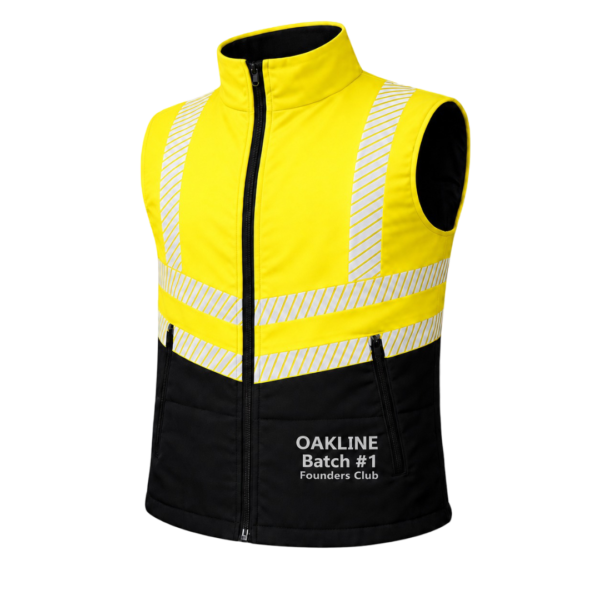
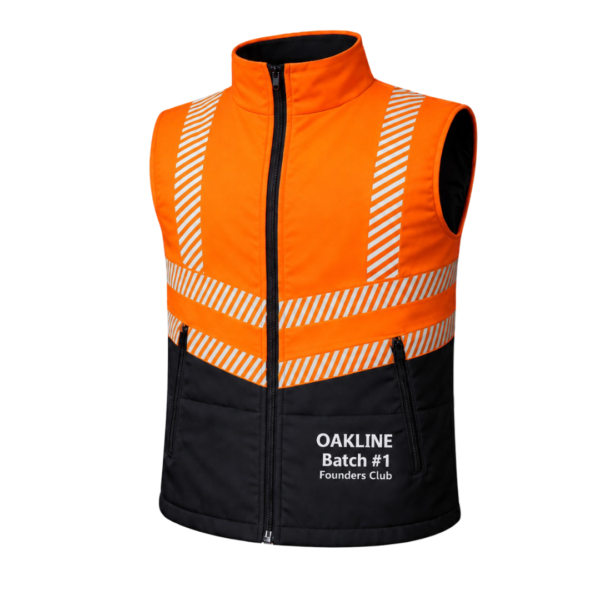
The Tod is OAKLINE’s hi-vis bodywarmer for businesses and tradespeople who want a sharper option.
Insulated sleeveless body. Contrast lower panels. Segmented reflective tape layout. A cleaner, more structured OAKLINE shape rather than the usual boxy cut.
The visual direction is deliberate. OAKLINE is not competing with the cheapest bodywarmer in the catalogue. It sits as premium-budget workwear: better fitting and better looking without corporate uniform pricing.
That suits site teams, warehouse operations, maintenance workforces and mobile trade businesses who want kit that does not look disposable.
Certification, performance class and suitability for a specific workplace must be confirmed against current verified documentation before issue.
For the full selection process, read the hi-vis bodywarmer buyer’s guide.
Wear frequency is part of the value calculation
The cheapest garment is not the lowest-cost outcome.
A product sitting in a locker, a van or a storage cupboard delivers nothing regardless of unit price.
Public procurement guidance reinforces that value for money is not determined by lowest initial price alone. It defines value through economy, efficiency, effectiveness and intended outcomes, with life-cycle cost normally considered for goods that are not basic single-use purchases.
Private buyers are not bound by that process. The commercial logic holds anyway.
When comparing bodywarmers, weigh:
- Whether the fit works across the actual team
- What workers will wear underneath
- How often the garment will realistically be used
- Whether it allows the required movements
- Whether repeat sizes will stay available
- Whether the supplier can provide verified certification documentation
- Whether the product presents the business properly
- Purchase price
That is a more useful comparison than a price column sorted low to high.
How to trial a hi-vis bodywarmer properly
Do not assess a bodywarmer in a thin t-shirt in a warm office.
Test the combination the worker will actually use.
Wear it over the intended sweatshirt or hoodie.
Zip it fully.
Sit in a van.
Reach into shelving.
Lift equipment.
Bend down.
Move between indoor and outdoor areas.
Then ask two questions: would you choose this at the start of a normal shift, and would you keep it on?
Feedback does not replace a risk assessment or technical documentation. It tells you whether the garment works for the people expected to wear it.
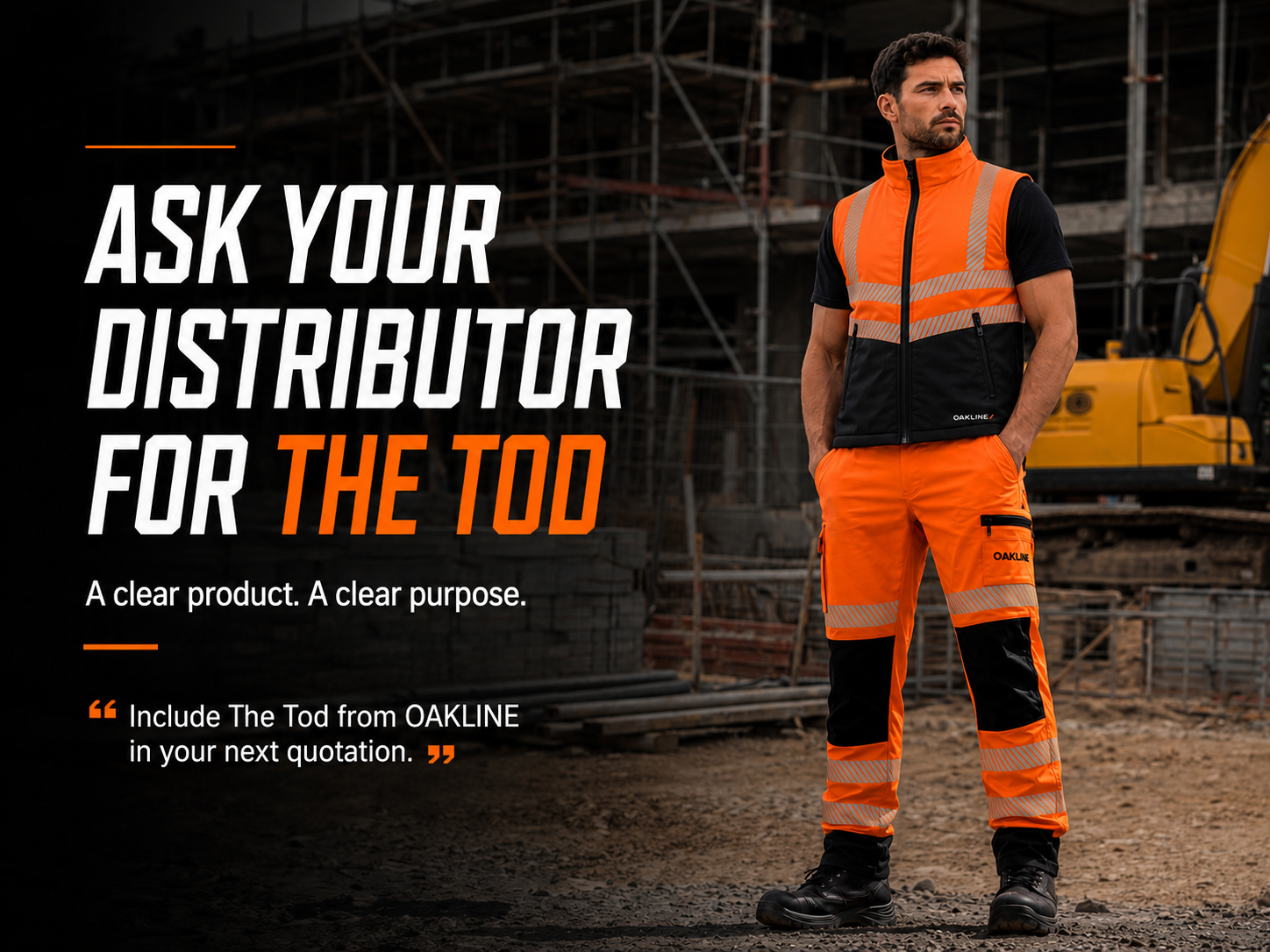
Ask your distributor for The Tod
You do not need to leave a trusted workwear supplier to specify OAKLINE.
Ask them to include The Tod in the next quotation:
“We want to trial a sharper hi-vis bodywarmer for cold starts and active shifts. It needs a modern fit, room for the intended underlayer and a realistic price for company issue. Please include The Tod from OAKLINE and supply current verified product and certification documentation.”
That gives the distributor a clear product and a clear purpose.
Hi-vis bodywarmer vs jacket FAQs
Should I issue a hi-vis bodywarmer or a jacket?
Most UK operations need both. Issue a bodywarmer for cold starts, active work and movement between indoor and outdoor areas. Issue a jacket for sustained cold, rain, wind and static roles. The deciding factor is your risk assessment and the certified class required for the task, not comfort preference alone.
Is a hi-vis bodywarmer warm enough for winter?
As a standalone outer layer in deep winter, usually not. It is designed to work as part of a layering system over a sweatshirt or hoodie, and to cover the long shoulder seasons where a jacket is more than the work requires.
Does a hi-vis bodywarmer offer the same protection as a jacket?
No universal comparison applies. Jackets and bodywarmers give different coverage and can hold different tested properties and classes. Sleeveless construction reduces the fluorescent background area available, so the class must be confirmed for the specific garment rather than carried across from a jacket.